
The Farmers’ Canvas
The beauty of Britain’s National Parks is not the work of nature alone, writes Kim Wilkie.
I can remember a furious argument as a teenager in Germany over beauty. In my clunky German I had been failing to convince my friends that there is a natural beauty which comes from an unselfconscious joy in life. I should have known better than to take on disciples of Hesse and Rilke on their own territory, let alone in their own language.
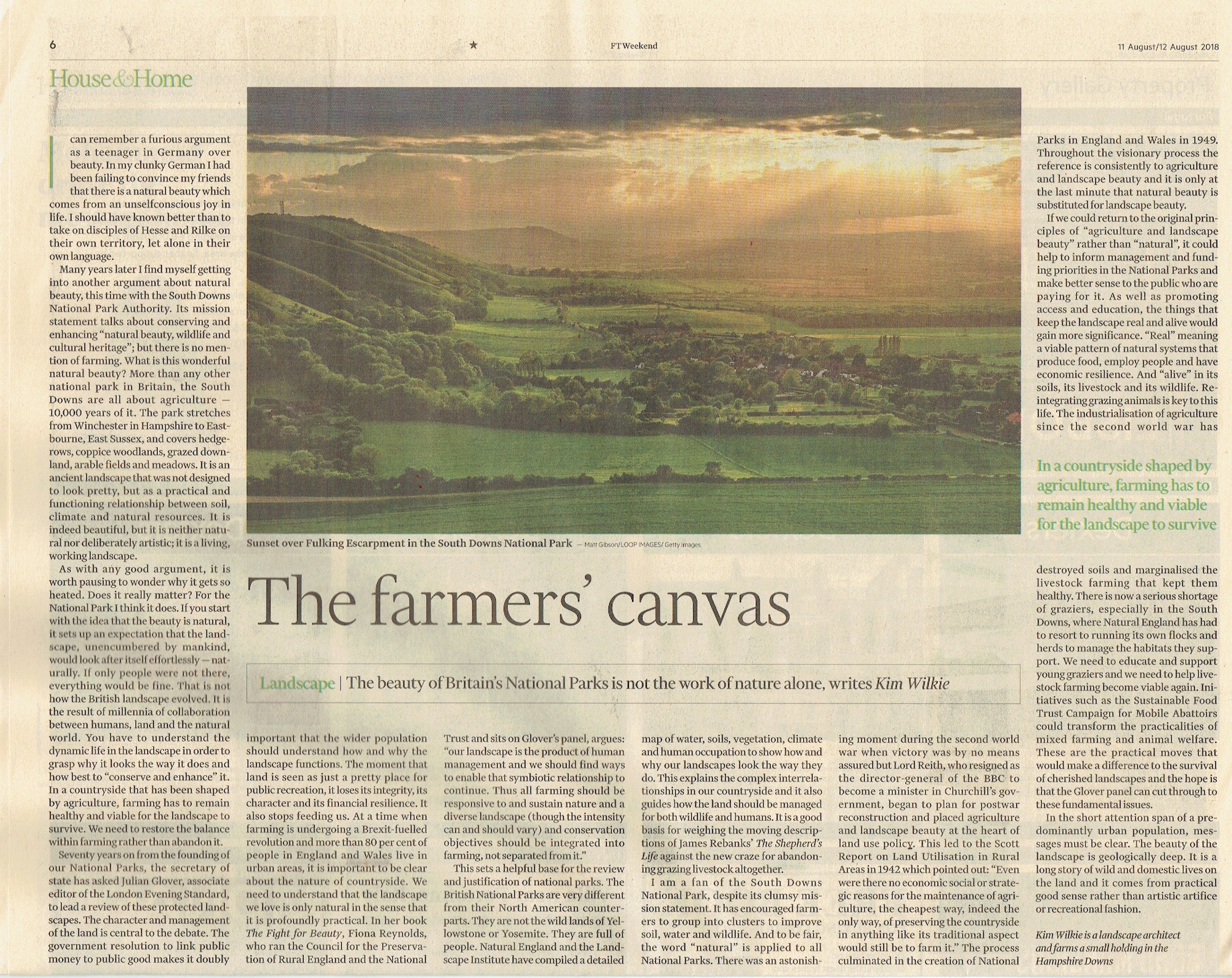
Many years later I find myself getting into another argument about natural beauty, this time with the South Downs National Park Authority. Its mission statement talks about conserving and enhancing “natural beauty, wildlife and cultural heritage”; but there is no mention of farming. What is this wonderful natural beauty? More than any other national park in Britain, the South Downs are all about agriculture — 10,000 years of it. The park stretches from Winchester in Hampshire to Eastbourne, East Sussex, and covers hedgerows, coppice woodlands, grazed downland, arable fields and meadows. It is an ancient landscape that was not designed to look pretty, but as a practical and functioning relationship between soil, climate and natural resources. It is indeed beautiful, but it is neither natural nor deliberately artistic; it is a living, working landscape.
As with any good argument, it is worth pausing to wonder why it gets so heated. Does it really matter? For the National Park I think it does. If you start with the idea that the beauty is natural, it sets up an expectation that the landscape, unencumbered by mankind, would look after itself effortlessly — naturally. If only people were not there, everything would be fine. That is not how the British landscape evolved. It is the result of millennia of collaboration between humans, land and the natural world. You have to understand the dynamic life in the landscape in order to grasp why it looks the way it does and how best to “conserve and enhance” it. In a countryside that has been shaped by agriculture, farming has to remain healthy and viable for the landscape to survive. We need to restore the balance within farming rather than abandon it.
Seventy years on from the founding of our National Parks, the secretary of state has asked Julian Glover, associate editor of the London Evening Standard, to lead a review of these protected landscapes. The character and management of the land is central to the debate. The government resolution to link public money to public good makes it doubly important that the wider population should understand how and why the landscape functions. The moment that land is seen as just a pretty place for public recreation, it loses its integrity, its character and its financial resilience. It also stops feeding us. At a time when farming is undergoing a Brexit-fuelled revolution and more than 80 per cent of people in England and Wales live in urban areas, it is important to be clear about the nature of countryside. We need to understand that the landscape we love is only natural in the sense that it is profoundly practical. In her book The Fight for Beauty, Fiona Reynolds, who ran the Council for the Preservation of Rural England and the National Trust and sits on Glover’s panel, argues: “our landscape is the product of human management and we should find ways to enable that symbiotic relationship to continue. Thus all farming should be responsive to and sustain nature and a diverse landscape (though the intensity can and should vary) and conservation objectives should be integrated into farming, not separated from it.”
This sets a helpful base for the review and justification of national parks. The British National Parks are very different from their North American counterparts. They are not the wild lands of Yellowstone or Yosemite. They are full of people. Natural England and the Landscape Institute have compiled a detailed map of water, soils, vegetation, climate and human occupation to show how and why our landscapes look the way they do. This explains the complex interrelationships in our countryside and it also guides how the land should be managed for both wildlife and humans. It is a good basis for weighing the moving descriptions of James Rebanks’ The Shepherd’s Life against the new craze for abandoning grazing livestock altogether.
I am a fan of the South Downs National Park, despite its clumsy mission statement. It has encouraged farmers to group into clusters to improve soil, water and wildlife. And to be fair, the word “natural” is applied to all National Parks. There was an astonishing moment during the second world war when victory was by no means assured but Lord Reith, who resigned as the director-general of the BBC to become a minister in Churchill’s government, began to plan for postwar reconstruction and placed agriculture and landscape beauty at the heart of land use policy. This led to the Scott Report on Land Utilisation in Rural Areas in 1942 which pointed out: “Even were there no economic social or strategic reasons for the maintenance of agriculture, the cheapest way, indeed the only way, of preserving the countryside in anything like its traditional aspect would still be to farm it.” The process culminated in the creation of National Parks in England and Wales in 1949. Throughout the visionary process the reference is consistently to agriculture and landscape beauty and it is only at the last minute that natural beauty is substituted for landscape beauty.
If we could return to the original principles of “agriculture and landscape beauty” rather than “natural”, it could help to inform management and funding priorities in the National Parks and make better sense to the public who are paying for it. As well as promoting access and education, the things that keep the landscape real and alive would gain more significance. “Real” meaning a viable pattern of natural systems that produce food, employ people and have economic resilience. And “alive” in its soils, its livestock and its wildlife. Re-integrating grazing animals is key to this life. The industrialisation of agriculture since the second world war has destroyed soils and marginalised the livestock farming that kept them healthy. There is now a serious shortage of graziers, especially in the South Downs, where Natural England has had to resort to running its own flocks and herds to manage the habitats they support. We need to educate and support young graziers and we need to help livestock farming become viable again. Initiatives such as the Sustainable Food Trust Campaign for Mobile Abattoirs could transform the practicalities of mixed farming and animal welfare. These are the practical moves that would make a difference to the survival of cherished landscapes and the hope is that the Glover panel can cut through to these fundamental issues.
In the short attention span of a predominantly urban population, messages must be clear. The beauty of the landscape is geologically deep. It is a long story of wild and domestic lives on the land and it comes from practical good sense rather than artistic artifice or recreational fashion.
The Farmers’ Canvas
The beauty of Britain’s National Parks is not the work of nature alone, writes Kim Wilkie.
I can remember a furious argument as a teenager in Germany over beauty. In my clunky German I had been failing to convince my friends that there is a natural beauty which comes from an unselfconscious joy in life. I should have known better than to take on disciples of Hesse and Rilke on their own territory, let alone in their own language.
Many years later I find myself getting into another argument about natural beauty, this time with the South Downs National Park Authority. Its mission statement talks about conserving and enhancing “natural beauty, wildlife and cultural heritage”; but there is no mention of farming. What is this wonderful natural beauty? More than any other national park in Britain, the South Downs are all about agriculture — 10,000 years of it. The park stretches from Winchester in Hampshire to Eastbourne, East Sussex, and covers hedgerows, coppice woodlands, grazed downland, arable fields and meadows. It is an ancient landscape that was not designed to look pretty, but as a practical and functioning relationship between soil, climate and natural resources. It is indeed beautiful, but it is neither natural nor deliberately artistic; it is a living, working landscape.
As with any good argument, it is worth pausing to wonder why it gets so heated. Does it really matter? For the National Park I think it does. If you start with the idea that the beauty is natural, it sets up an expectation that the landscape, unencumbered by mankind, would look after itself effortlessly — naturally. If only people were not there, everything would be fine. That is not how the British landscape evolved. It is the result of millennia of collaboration between humans, land and the natural world. You have to understand the dynamic life in the landscape in order to grasp why it looks the way it does and how best to “conserve and enhance” it. In a countryside that has been shaped by agriculture, farming has to remain healthy and viable for the landscape to survive. We need to restore the balance within farming rather than abandon it.
Seventy years on from the founding of our National Parks, the secretary of state has asked Julian Glover, associate editor of the London Evening Standard, to lead a review of these protected landscapes. The character and management of the land is central to the debate. The government resolution to link public money to public good makes it doubly important that the wider population should understand how and why the landscape functions. The moment that land is seen as just a pretty place for public recreation, it loses its integrity, its character and its financial resilience. It also stops feeding us. At a time when farming is undergoing a Brexit-fuelled revolution and more than 80 per cent of people in England and Wales live in urban areas, it is important to be clear about the nature of countryside. We need to understand that the landscape we love is only natural in the sense that it is profoundly practical. In her book The Fight for Beauty, Fiona Reynolds, who ran the Council for the Preservation of Rural England and the National Trust and sits on Glover’s panel, argues: “our landscape is the product of human management and we should find ways to enable that symbiotic relationship to continue. Thus all farming should be responsive to and sustain nature and a diverse landscape (though the intensity can and should vary) and conservation objectives should be integrated into farming, not separated from it.”
This sets a helpful base for the review and justification of national parks. The British National Parks are very different from their North American counterparts. They are not the wild lands of Yellowstone or Yosemite. They are full of people. Natural England and the Landscape Institute have compiled a detailed map of water, soils, vegetation, climate and human occupation to show how and why our landscapes look the way they do. This explains the complex interrelationships in our countryside and it also guides how the land should be managed for both wildlife and humans. It is a good basis for weighing the moving descriptions of James Rebanks’ The Shepherd’s Life against the new craze for abandoning grazing livestock altogether.
I am a fan of the South Downs National Park, despite its clumsy mission statement. It has encouraged farmers to group into clusters to improve soil, water and wildlife. And to be fair, the word “natural” is applied to all National Parks. There was an astonishing moment during the second world war when victory was by no means assured but Lord Reith, who resigned as the director-general of the BBC to become a minister in Churchill’s government, began to plan for postwar reconstruction and placed agriculture and landscape beauty at the heart of land use policy. This led to the Scott Report on Land Utilisation in Rural Areas in 1942 which pointed out: “Even were there no economic social or strategic reasons for the maintenance of agriculture, the cheapest way, indeed the only way, of preserving the countryside in anything like its traditional aspect would still be to farm it.” The process culminated in the creation of National Parks in England and Wales in 1949. Throughout the visionary process the reference is consistently to agriculture and landscape beauty and it is only at the last minute that natural beauty is substituted for landscape beauty.
If we could return to the original principles of “agriculture and landscape beauty” rather than “natural”, it could help to inform management and funding priorities in the National Parks and make better sense to the public who are paying for it. As well as promoting access and education, the things that keep the landscape real and alive would gain more significance. “Real” meaning a viable pattern of natural systems that produce food, employ people and have economic resilience. And “alive” in its soils, its livestock and its wildlife. Re-integrating grazing animals is key to this life. The industrialisation of agriculture since the second world war has destroyed soils and marginalised the livestock farming that kept them healthy. There is now a serious shortage of graziers, especially in the South Downs, where Natural England has had to resort to running its own flocks and herds to manage the habitats they support. We need to educate and support young graziers and we need to help livestock farming become viable again. Initiatives such as the Sustainable Food Trust Campaign for Mobile Abattoirs could transform the practicalities of mixed farming and animal welfare. These are the practical moves that would make a difference to the survival of cherished landscapes and the hope is that the Glover panel can cut through to these fundamental issues.
In the short attention span of a predominantly urban population, messages must be clear. The beauty of the landscape is geologically deep. It is a long story of wild and domestic lives on the land and it comes from practical good sense rather than artistic artifice or recreational fashion.