
The Brighton Downs
Kim Wilkie explains why grazed chalk grasslands is so important, and why the Brighton Downs could become a template for the whole South Downs.
One hundred years ago, Brighton City Council resolved to buy 20 square miles of the chalk downland surrounding the city to protect its aquifer and water supply. It was a brilliant decision and really prescient. A city’s setting is as important as its core; not just for clean water and air but also for food, wildlife and human sanity.
Brighton and Hove are now consulting on how to manage their downlands for the next hundred years. It is a perfect moment as water shortage, climate crisis, recalibration of agriculture and COVID-19 revelations of the value of open space all coincide.
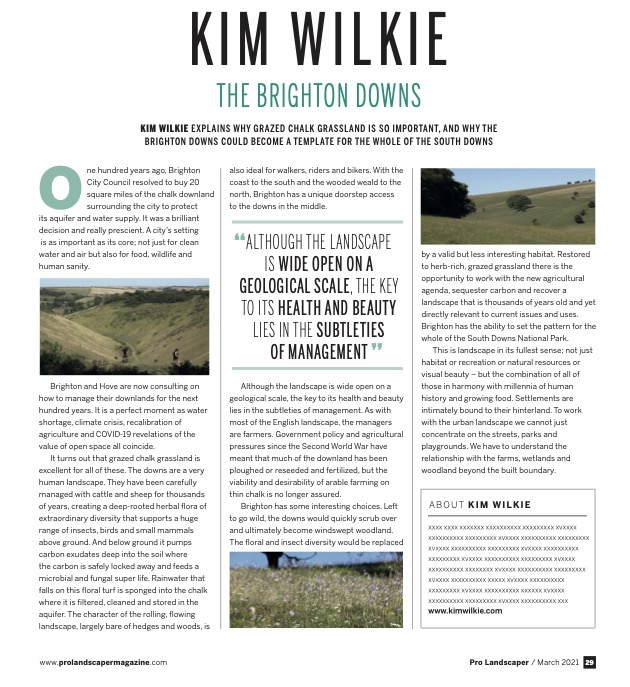
It turns out that grazed chalk grassland is excellent for all of these. The downs are a very human landscape. They have been carefully managed with cattle and sheep for thousands of years, creating a deep-rooted herbal flora of extraordinary diversity that supports a huge range of insects, birds and small mammals above ground. And below ground it pumps carbon exudates deco into the soil where the carbon is safely locked away and feeds a microbial and fungal super life. Rainwater that falls on this floral turf is sponged into the chalk where it is filtered, cleaned and stored in the aquifer. The character of the rolling, flowing landscape, largely bare of hedges and woods, is also ideal for walkers, riders and bikers. With the coast to the south and the wooded weald to the north, Brighton has a unique doorstep access to the downs in the middle.
Although the landscape is wide open on a geological scale, the key to its health and beauty lies in the subtleties of management. As with most of the English landscape, the managers are farmers. Government policy and agricultural pressures since the Second World War have meant that much of the downland has been ploughed or reseeded and fertilized, but the viability and desirability of arable farming on thin chalk is no longer assured.
Brighton has some interesting choices. Left to go wild, the Downs would quickly scrub over and ultimately become windswept woodland. The floral and insect diversity would be replaced by a valid but less interesting habitat. Restored to herb-rich, grazed grassland there is the opportunity to work with the new agricultural agenda, sequester carbon and recover a landscape that is thousands of years old and yet directly relevant to current issues and uses.
Brighton has the ability to set the pattern for the whole of the South Downs National Park.
This is landscape in its fullest sense: not just habitat or recreation or natural resources or visual beauty – but the combination of all of those in harmony with millennia of human history and growing food. Settlements are intimately bound to their hinterland. To work with the urban landscape we cannot just concentrate on the streets, parks and playgrounds. We have to understand the relationship with the farms, wetlands and woodland beyond the built boundary.
The Brighton Downs
Kim Wilkie explains why grazed chalk grasslands is so important, and why the Brighton Downs could become a template for the whole South Downs.
One hundred years ago, Brighton City Council resolved to buy 20 square miles of the chalk downland surrounding the city to protect its aquifer and water supply. It was a brilliant decision and really prescient. A city’s setting is as important as its core; not just for clean water and air but also for food, wildlife and human sanity.
Brighton and Hove are now consulting on how to manage their downlands for the next hundred years. It is a perfect moment as water shortage, climate crisis, recalibration of agriculture and COVID-19 revelations of the value of open space all coincide.
It turns out that grazed chalk grassland is excellent for all of these. The downs are a very human landscape. They have been carefully managed with cattle and sheep for thousands of years, creating a deep-rooted herbal flora of extraordinary diversity that supports a huge range of insects, birds and small mammals above ground. And below ground it pumps carbon exudates deco into the soil where the carbon is safely locked away and feeds a microbial and fungal super life. Rainwater that falls on this floral turf is sponged into the chalk where it is filtered, cleaned and stored in the aquifer. The character of the rolling, flowing landscape, largely bare of hedges and woods, is also ideal for walkers, riders and bikers. With the coast to the south and the wooded weald to the north, Brighton has a unique doorstep access to the downs in the middle.
Although the landscape is wide open on a geological scale, the key to its health and beauty lies in the subtleties of management. As with most of the English landscape, the managers are farmers. Government policy and agricultural pressures since the Second World War have meant that much of the downland has been ploughed or reseeded and fertilized, but the viability and desirability of arable farming on thin chalk is no longer assured.
Brighton has some interesting choices. Left to go wild, the Downs would quickly scrub over and ultimately become windswept woodland. The floral and insect diversity would be replaced by a valid but less interesting habitat. Restored to herb-rich, grazed grassland there is the opportunity to work with the new agricultural agenda, sequester carbon and recover a landscape that is thousands of years old and yet directly relevant to current issues and uses.
Brighton has the ability to set the pattern for the whole of the South Downs National Park.
This is landscape in its fullest sense: not just habitat or recreation or natural resources or visual beauty – but the combination of all of those in harmony with millennia of human history and growing food. Settlements are intimately bound to their hinterland. To work with the urban landscape we cannot just concentrate on the streets, parks and playgrounds. We have to understand the relationship with the farms, wetlands and woodland beyond the built boundary.